Spanner Set Sizes: The Ones You Actually Reach For
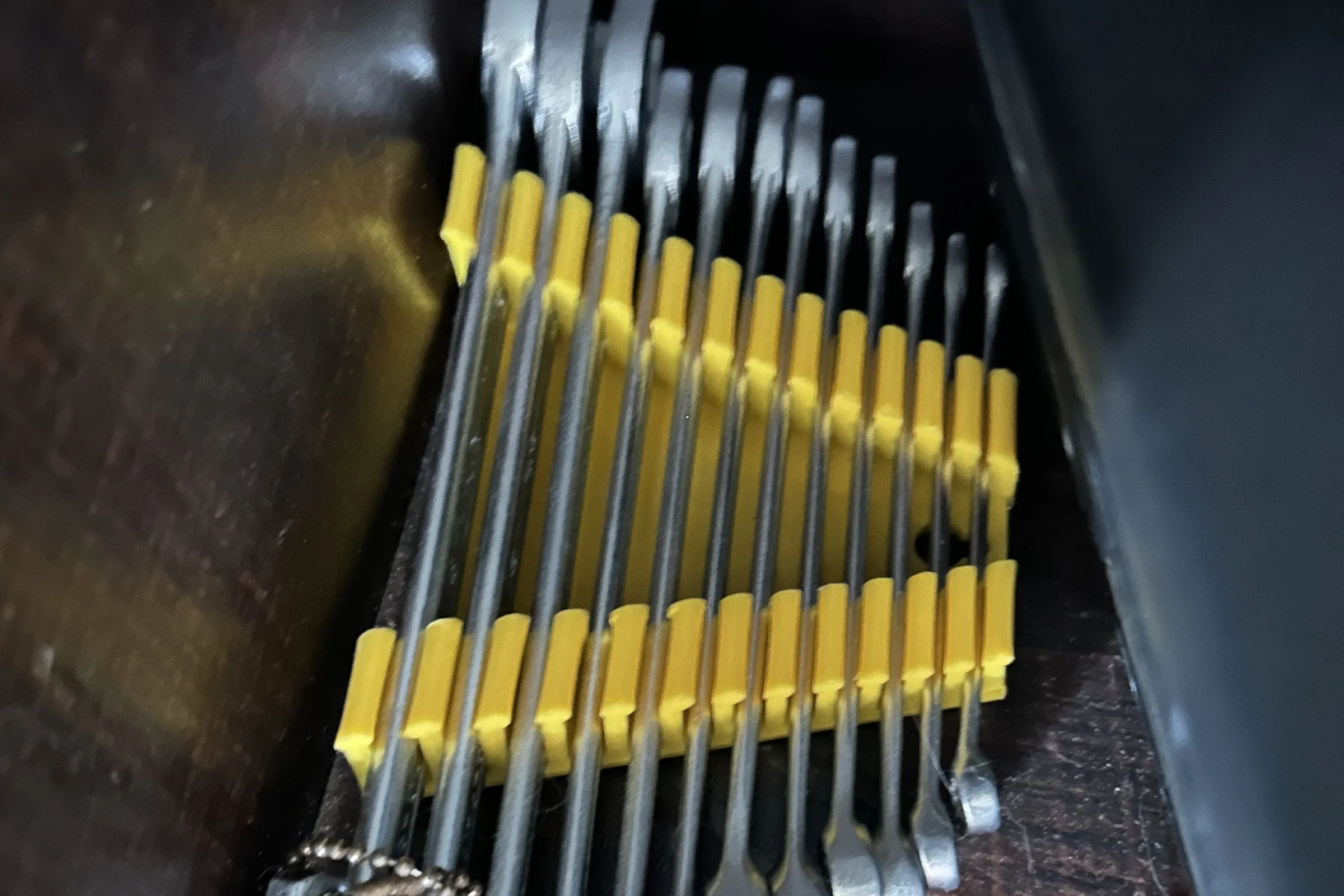
A combination spanner has an open jaw at one end and a closed ring at the other, both the same size. It is the most useful shape a spanner comes in, and a set of them covers a surprising amount of work that people buy far more expensive tools for.
The question is never really “which brand”. It is which sizes you will use, and which end of the spanner you should be using when it matters.
The sizes that actually get used
In metric, the working range for domestic and light automotive work is 8 mm to 19 mm. That is a dozen sizes, and within it a handful do most of the work:
| Size | Where it turns up |
|---|---|
| 8, 10 mm | Small brackets, battery terminals, appliance panels, bicycle work |
| 12, 13 mm | Furniture bolts, mower blades, general assembly |
| 14, 15 mm | Suspension and bracket bolts on smaller cars |
| 17, 19 mm | Larger chassis bolts, some drain plugs |
10 mm and 13 mm go missing more than all the others combined. They are the two most-used sizes in the range, which is why every mechanic jokes about losing them. If a set offers a spare of anything, that is where it is worth having.
Sizes below 8 mm exist and are largely for electronics and model work. Sizes above 19 mm are real but specialised — wheel nuts, big suspension components — and they belong on a socket and a long bar rather than a spanner, because you cannot safely apply that much torque to a short handle.
Imperial only matters if your things are imperial. Older American vehicles, some machinery and a lot of plumbing fittings still are. If nothing you own is, a combined metric-and-imperial set is half a set you will never open.
Use the ring end unless you cannot
This is the part that gets skipped, and it is the difference between undoing a bolt and rounding it off.
The ring end wraps the fastener completely. It grips all six corners, spreads the load around the head, and is very hard to slip off. The open end grips two flats only, and under load it wants to spring apart and slide — which is exactly how a hex head turns into a circle.
So: ring end for anything tight. Use the open end only when the ring physically cannot go on — a pipe union, a brake line, a bolt with something threaded past it. When the open end is the only option, pull the spanner rather than push, and keep it square to the head.
There is a related detail worth knowing. Ring ends come in six-point and twelve-point. Twelve-point is more convenient because it re-seats every 30 degrees instead of every 60, which matters in a tight space. Six-point grips more of each flat and is what you want on anything corroded or already slightly rounded. Most sets are twelve-point; if you have the choice on a stubborn bolt, six-point is the safer tool.
Where spanners beat sockets, and where they lose
A socket set is faster and applies more torque safely. If you can get a socket on the fastener, you generally should.
Spanners win in two situations, and both are common:
Where a socket will not fit. A socket needs clearance for the socket walls plus the ratchet head behind it. A spanner needs the thickness of the spanner. Bolts recessed into castings, fittings close against a bulkhead, anything with a pipe running past it — these are spanner jobs.
Where you need two tools at once. A nut and bolt tightened against each other needs one spanner holding while the other turns. A ratchet in each hand does not work in the space most of these live in.
Reading a set before you buy it
A few things are visible from the outside and worth checking:
- Marked sizes you can still read. Stamped and filled markings survive; a printed size on a chrome face wears off, and an unmarked spanner is a guess-and-try every time.
- Chrome vanadium steel, usually marked “Cr-V”. This is the ordinary standard for hand spanners and is what you want. Its absence on an unbranded set is a reasonable warning sign.
- Thin, clean jaws. Thick castings are cheap to make and will not fit into the recessed places that are the whole reason you own spanners.
- A holder or roll. Loose spanners in a drawer become a drawer you rummage in. A rail or a roll keeps them in size order, which is how you notice the 13 is missing before you need it.
Ratcheting spanners: useful, with a limit
A ratcheting ring end saves a lot of time where you can only get a few degrees of swing. They are genuinely good, and for repetitive work they are worth owning.
The limit is that the ratcheting mechanism sits inside the ring, so the ring is bulkier and the mechanism is the weakest part of the tool. On a seized fastener the sensible sequence is to break it loose with a plain ring spanner — or a socket and a breaker bar — and then use the ratcheting spanner to wind it out.
Looking after them
Spanners are close to maintenance-free, which is why people neglect the one thing that matters: keep the jaws and rings clean and dry. Oil in a ring end makes it slip on the flats. Rust pitting inside a ring reduces contact area on exactly the surfaces that carry the load.
Wipe them before they go away, and if a spanner has been used on something greasy, wipe the ring out rather than just the outside. A spanner that has been dropped on a hard floor is worth a look too — a spread open end never comes back, and a spanner that has started to open up will round the next bolt it touches.