Hot Glue Gun: What It Actually Holds, and What It Will Not
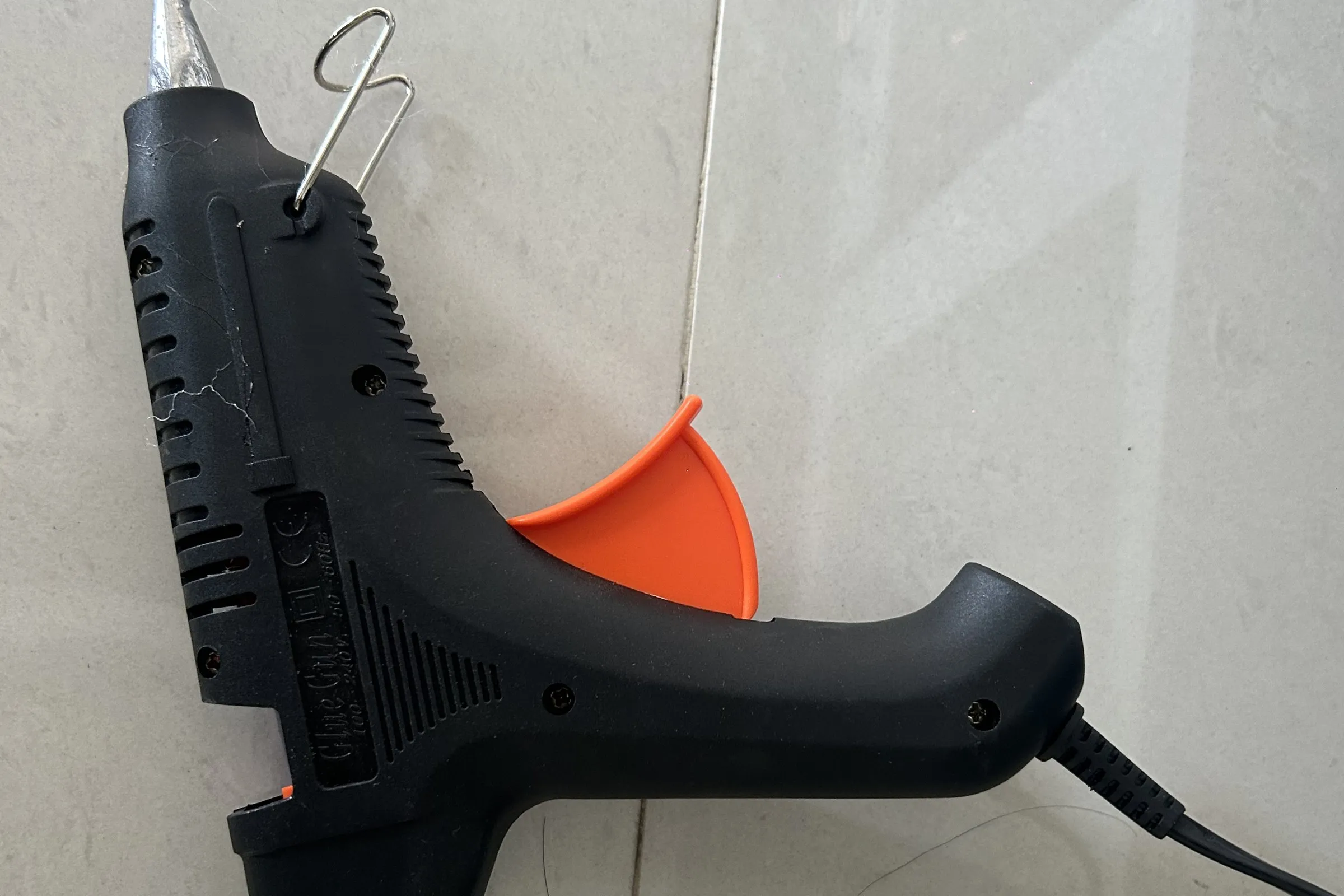
Hot glue is thermoplastic. It is solid, you melt it, it flows into whatever surface texture is available, and it goes solid again as it cools. Everything that is good and bad about it follows from that one sentence.
It grips because it flows into pores and then hardens inside them. So it holds well on anything porous and badly on anything smooth. And because it softens with heat, anything warm undoes it.
What it is genuinely good at
- Card, paper, fabric, felt, cork, untreated wood. Porous, light, and the glue keys into the surface. This is what the tool is for.
- Holding something while a real adhesive cures. A bead of hot glue as a temporary clamp is a legitimate workshop trick.
- Tidying and strain-relieving cables. A blob where a thin cable meets a connector stops the flexing that eventually breaks the conductor.
- Sealing a gap that will never be load-bearing. Draught-stopping a gap behind a fitting, filling an unused hole in a plastic housing.
- Anything you may want to reverse. Hot glue picks off. That is a feature as often as it is a weakness.
What it will not do
It is not structural. A joint that carries weight, gets pulled, or takes vibration will fail, and it will fail suddenly rather than gradually. Do not use it on anything whose failure matters — never on a repair that holds weight above someone, and never on anything electrical beyond strain relief.
It fails with heat. Standard hot melt softens somewhere around 60 °C. A car dashboard in summer, a windowsill in direct sun, anything near a bulb or a motor — the joint will creep and then let go. This is the most common surprise.
It does not stick to polypropylene or polyethylene. These are the waxy, slightly greasy-feeling plastics: most food containers, many storage boxes, bottle caps, plastic garden furniture. Nothing keys into them. If a plastic feels slick and flexes without whitening, expect the glue to peel off in one piece.
It does not stick to anything oily, dusty or wet, and it is poor on smooth metal and glass, where there is no texture to flow into. Roughing a smooth surface with abrasive paper first makes a real difference.
It is not a gap-filler that stays put. It shrinks slightly as it cools, so a thick blob pulls away from the edges of the gap it was meant to fill.
Choosing a gun: wattage and stick size
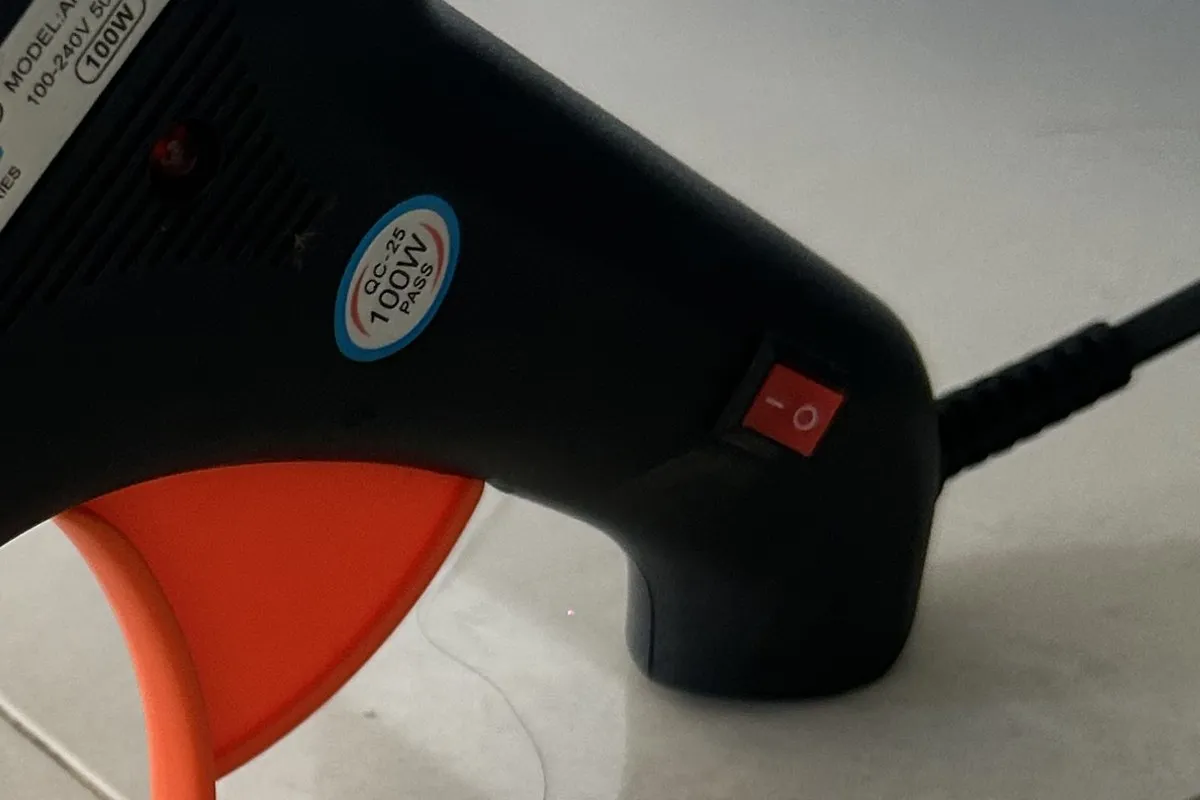
Wattage sets how fast it melts and how well it keeps up. Small craft guns are around 20 to 40 W: fine for occasional light work, slow to heat, and they cool down while you use them so the glue goes stringy and stops flowing properly. A full-size gun of around 100 W — the round blue badge in the photo above reads 100 W, and the rating is usually marked somewhere similar — heats in a couple of minutes and keeps melting at the rate you are squeezing. If you expect to use it for more than a few minutes at a time, that difference matters more than any other feature.
Stick diameter is 7 mm or 11 mm and they are not interchangeable. 11 mm is the common full-size standard and gives more glue per squeeze. Buy the gun first and the sticks to match it; a cupboard of the wrong diameter is a common and irritating mistake.
An on/off switch is worth having. Cheaper guns have none and are live whenever plugged in, which means unplugging is the only way to turn them off, and the natural habit becomes leaving it plugged in.
A stand that actually holds it. A glue gun always drips from the nozzle while hot. A fold-out stand keeps the tip off the surface. Look for one that folds far enough forward to hold the gun steady rather than balancing it.
Low-temperature and high-temperature
Some guns and sticks are low-temperature, running around 120 °C rather than about 190 °C. The trade is exactly what you would expect: low-temp is safer and suits delicate materials — thin foam, some fabrics, anything that would scorch — and its bond is weaker. High-temp flows further into a surface and holds better.
Dual-temperature guns exist and are a reasonable compromise. What matters is not mixing up the sticks: low-temp glue in a high-temp gun becomes very runny, and high-temp sticks in a low-temp gun will not melt properly.
Working with it, briefly
- Let it reach temperature. Squeezing a cold gun forces unmelted stick through and can damage the feed mechanism.
- Work fast. Standard hot melt sets in fifteen to thirty seconds. Position the pieces before you glue, not after.
- Press and hold. The bond forms as it cools, not on contact.
- Stringing means the glue is too cool — a gun that has been sitting idle, or one whose wattage is not keeping up.
- Do not touch a run-off to test it. At around 190 °C it sticks to skin while it burns, which is what makes glue-gun burns worse than they sound. Cold water first, and let the glue come off on its own.
When to reach for something else
Half of using hot glue well is knowing when not to.
- Superglue (cyanoacrylate) for small, close-fitting, rigid joints — ceramic, hard plastics, a clean break in something brittle. It needs the two faces to meet properly; it will not bridge a gap.
- Two-part epoxy for anything structural, anything that will get warm, and for filling a gap while it bonds. It takes minutes to hours to cure rather than seconds, which is the price of the strength.
- Contact adhesive for large flat areas — laminate, veneer, fabric onto board — where hot glue would cool before you covered the surface.
- Double-sided tape where you might want the thing off again cleanly, and where the load is light. Often the honest answer for mounting something to a painted wall.
- Polyurethane construction adhesive for outdoor and structural work, where the joint has to survive weather and load.
The pattern: hot glue is for speed, porous materials and reversibility. As soon as strength, heat or the outdoors enter the picture, it is the wrong tool.
Storing it
Let it cool completely on its stand before it goes away, and pull the remaining stick out if it will be months — a stick left in the chamber can seize in there as it cools and reheats. Keep sticks somewhere dry and not warm; they pick up dust that ends up in the joint, and in a hot cupboard they can deform enough to jam the feed.