RC Car Won't Move: The Checks That Fix Most of Them
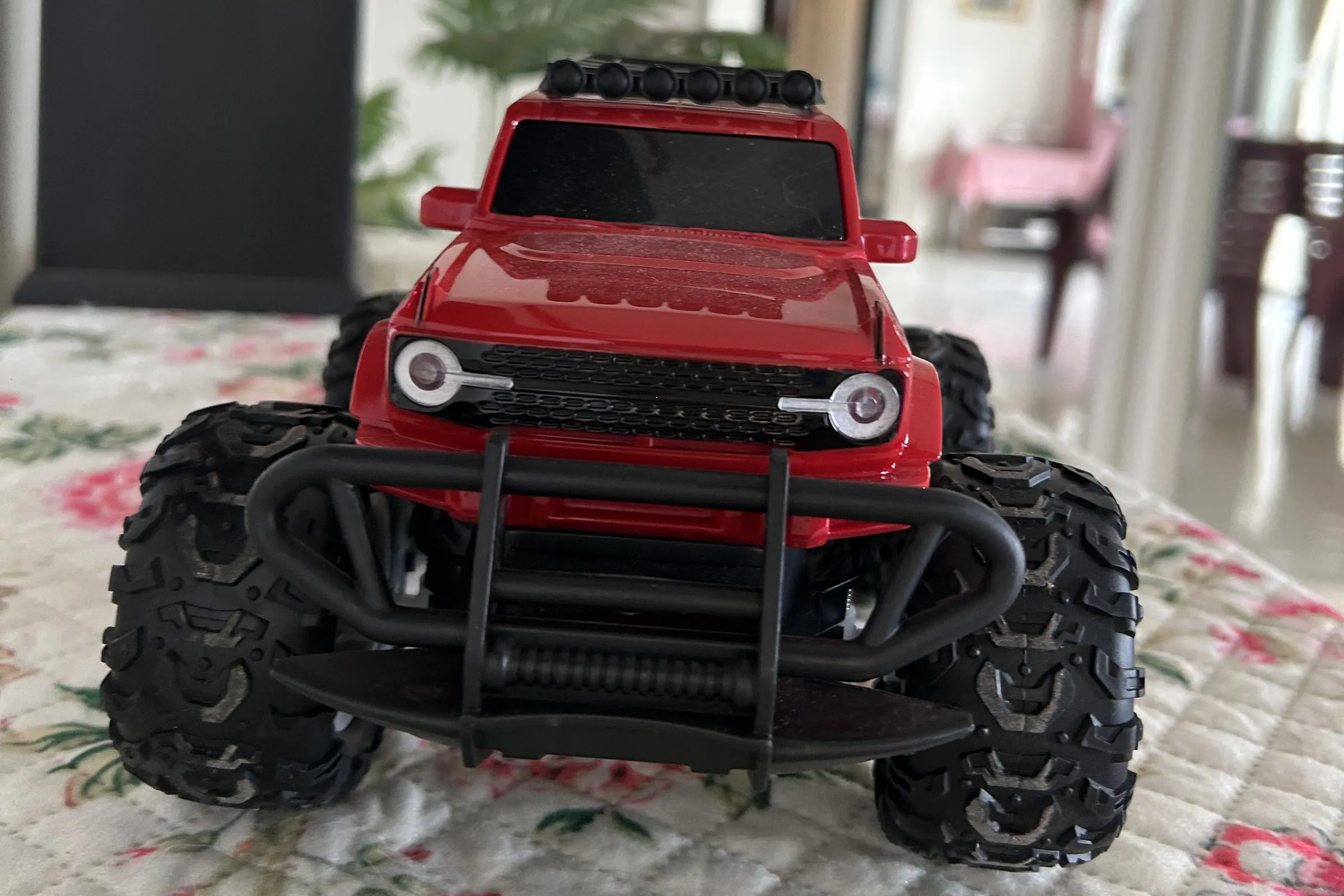
A radio-controlled car that has stopped responding is usually not broken. On the cheap-to-mid range models that make up most of what is sold, the fault is nearly always one of five things, and the first three cost nothing to rule out.
Work through them in this order. It is roughly cheapest-and-likeliest first, which is also the order that avoids taking anything apart.
Start here: there are two batteries, not one
This is the single most common reason a working car appears dead, and it catches people because modern toy cars have moved to USB charging while their controllers have not.
The car itself usually has a built-in rechargeable pack, charged through a USB port on the chassis. The controller usually runs on ordinary cells — typically two or three AA — in a compartment on the back.
So the two run down independently. A car that has been charged all night will still do nothing if the controller’s cells went flat three months ago. The giveaway is that the car powers up normally — a light comes on, you may hear a faint tone — and simply ignores the sticks.
Check both before you conclude anything.
1. Charge the car, and give it long enough
Plug the car in and leave it. A few things worth knowing about these packs:
- A more powerful charger will not charge it faster. The rate is set by the charging circuit inside the car, not by the plug. A 65 W laptop charger and a 5 W phone charger will fill it in about the same time.
- Most take two to four hours from flat. A ten-minute top-up before a birthday party is not enough.
- A charge light usually changes colour or goes out when it is done. If it never changes, suspect the cable before the car — cheap USB cables fail far more often than charging circuits, and a cable that still charges your phone can be too high-resistance for a slower charger to work through.
There is one failure worth knowing about, because it is not repairable. These packs are lithium cells, and a lithium cell left completely flat for months can drop below the voltage its protection circuit will allow to be recharged. If a car has been in a cupboard since last summer and now will not take any charge at all, that is the likely explanation, and no amount of waiting will bring it back.
2. Fresh cells in the controller
Not “the ones out of the TV remote”. Two specific things:
- Alkaline cells are 1.5 V; rechargeable NiMH cells are 1.2 V. Three rechargeables give 3.6 V where three alkalines give 4.5 V. Some cheap controllers are marginal on rechargeables even when those are fully charged, and behave as though the batteries are dying.
- Look at the contacts. White or green crust means a cell has leaked. Scrape it off with a small screwdriver or an old toothbrush until the metal is bright again — a corroded spring makes intermittent contact, which produces exactly the “works sometimes” behaviour people assume is a broken car.
3. Switch them on in the right order
Almost everything now runs on 2.4 GHz, where the controller and the car pair themselves each time they are switched on. That pairing usually expects a particular order, and getting it wrong looks identical to a broken car.
The order that works for most:
- Switch both off, properly.
- Switch the car on and stand it still on the floor. Do not hold it.
- Switch the controller on within a few seconds.
A light that blinks and then goes solid usually means it has paired. A light that blinks forever usually means it has not. If your model’s instructions give the opposite order, follow those — the point is that the order is deliberate, not that one order is universal.
Holding the car while it powers up is worth avoiding for a second reason: many of them calibrate their steering centre at switch-on, and a hand pressing on the wheels can leave it permanently pulling to one side.
4. Find the switch itself
On most models the power switch is underneath, and it is easy to knock into the off position when the car is thrown into a toy box.
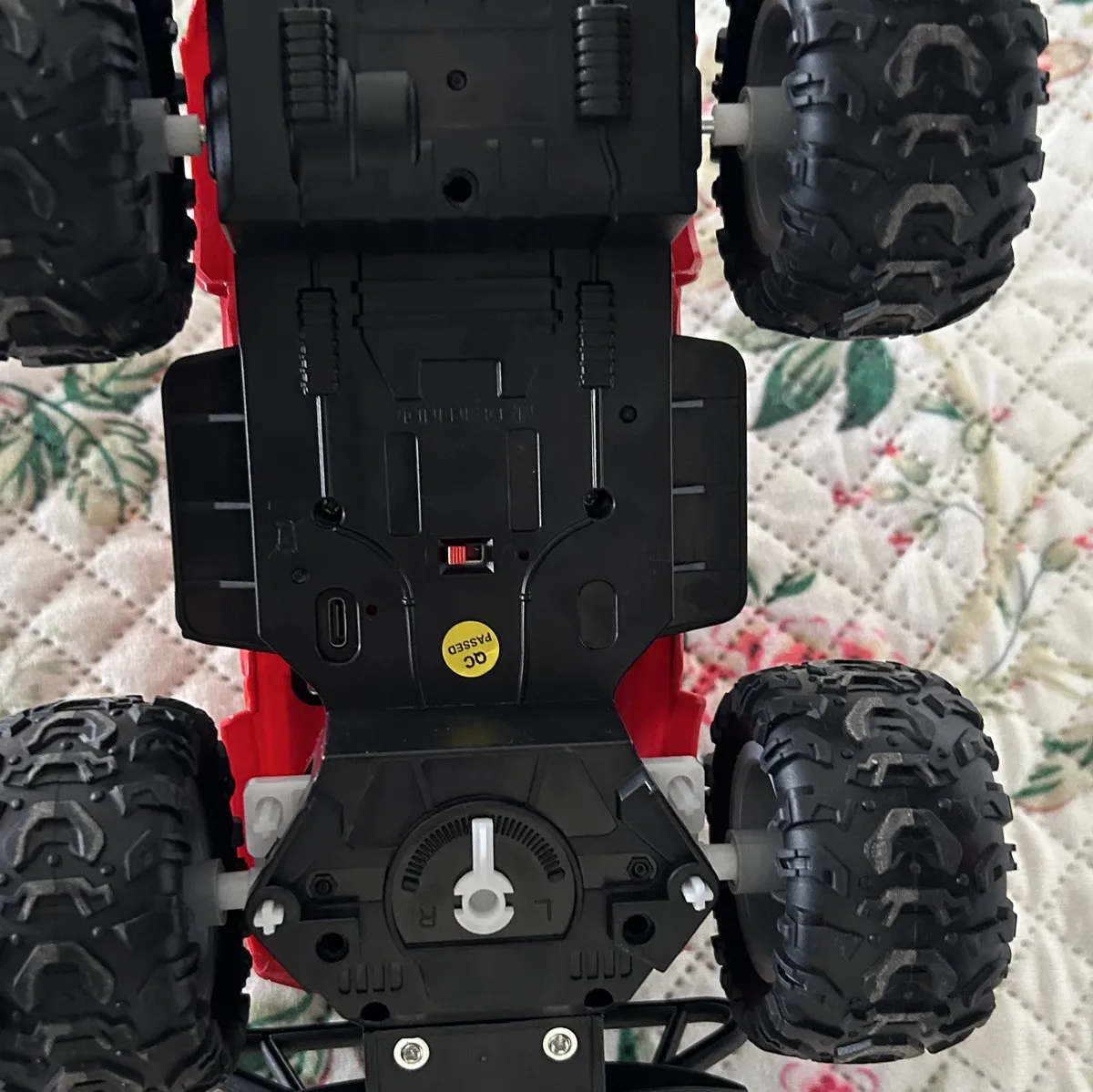
The photo above shows the layout on a typical model — the red slide switch sits in the centre of the chassis, with the USB-C charging port a few centimetres away. Both are easy to miss if you are not expecting them, and worth locating before you decide anything is wrong.
5. The motor runs but the car does not move
If you can hear it whirring and nothing happens, the drive is not reaching the wheels. Two causes cover almost all of it.
Hair and carpet fibre wound round the axles. This is by far the most common, and it is worse on carpet and in homes with pets or long hair. Turn the car over and look closely where each wheel meets the body. A tight black band of fibre builds up on the axle and eventually stops it turning. Pick it off with tweezers, or cut it with a craft knife blade held flat against the axle so you do not gouge the plastic.
A stripped gear. The pinion on the motor and the larger spur gear it drives are usually plastic. If a car has been run hard, driven into walls, or had a wheel held while the motor was powered, the teeth round off. The sound is distinctive — a rapid clicking or buzzing that changes pitch when you press harder on the throttle.
To tell these apart: switch the car off and turn a wheel by hand. Fibre round an axle feels tight and gritty. A stripped gear turns freely but the wheel does not resist at all when you try to turn it backwards against the motor.
It steers but will not drive, or drives but will not steer
These are separate channels, and on most cars separate motors, so one failing while the other works is normal rather than strange. If steering works, the controller, the pairing and the receiver are all fine — which narrows a no-drive fault down to the drive motor, its wiring, or the gears above.
Range, and cars that cut out across the room
2.4 GHz models generally manage twenty to thirty metres in the open and much less through walls. If a car works close up and stutters further away, that is usually range or a weak controller battery rather than a fault.
Older cars on 27 MHz or 49 MHz — the ones with a telescopic metal aerial — have a different problem. Only a handful of channels exist, so two cars on the same frequency will drive each other. If a second car appeared in the house recently, that is worth ruling out before anything else.
When it is not worth fixing
Worth being realistic. On an inexpensive car, replacement gears and packs are usually not sold separately, the body is glued or riveted rather than screwed, and an hour of fiddling can be worth more than the car. Fibre round an axle, flat batteries and a pairing problem are all worth fixing. A stripped spur gear in a sealed gearbox, on a car that cost less than a takeaway, generally is not.
Storing it so this does not happen again
Lithium packs do not like being stored flat, which is what kills most toy cars over a winter. If it is going away for months, charge it for an hour or so first — somewhere near half full is kinder than either extreme — and take the cells out of the controller so a leak cannot destroy the contacts.